Descent modes
A vertical path and a speed-based descent use different guidance. In both cases, monitor the next restriction and the aircraft’s speed.
For an early descent, first obtain a lower clearance and set the cleared altitude. FSS describes DES NOW as an early path-descent option when available. In version 1.1.0, FSS says DES NOW maintains 1,000 ft/min until the path becomes steep enough. Check the FMA and continue to monitor speed, altitude and the planned path. For a normal VNAV path descent, FSS specifies FMS as the navigation source with LNAV and VNAV active. FSS Service Update 1 [2].
Arrival constraints
Check charted constraints, current clearance, route, anticipated runway and approach. Note where deceleration and configuration changes will be needed.
Check the FMS
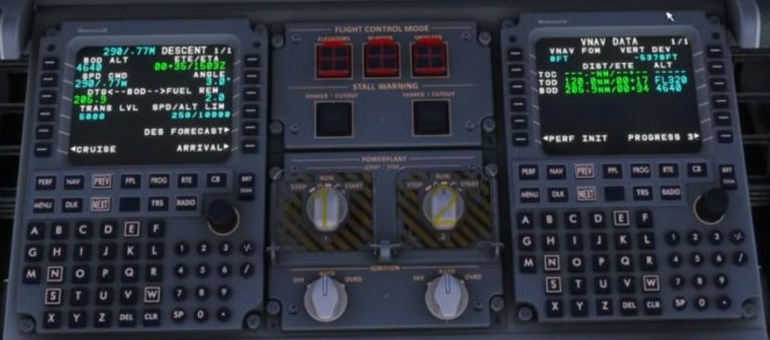
Confirm the route and performance data. Look for a plausible top of descent, next constraint and speed schedule.
Set the cleared altitude
When appropriate, set the next cleared lower altitude. Confirm the preselector value before expecting a descent.
Observe path capture
With the appropriate source and VNAV selected, check the armed and active modes and vertical deviation. A path line is not the same as an active PTH annunciation.
Understand selected FLCH
In FLCH, FSS describes pitch controlling the selected speed. Actual descent rate depends on thrust and aircraft energy; this is not the same as commanding a particular geometric path.
Changed clearance
Stabilise first, make the route or mode change, then check the active leg, FMA and resulting profile.
Descent energy
A descent that is on altitude but too fast may still be poorly prepared for the next restriction. Watch energy, configuration and the actual clearance together.
If you are high on the arrival, check your clearance, speed and available distance. A steeper descent can make deceleration harder. Check the FSS speedbrake restrictions, flap limits and active FMA before changing configuration or mode. If the approach cannot be stabilised, go around. [38] [24]