The next aircraft
In June 2022, an E195-E2 spent seventy minutes in the air with one engine running on 100 per cent sustainable aviation fuel. Pratt & Whitney and Embraer had completed ground tests before the flight. The demonstration put a different fuel through an engine and aircraft installation already in use, while work continued on the standards and approvals required for wider operation.
The carbon accounting began well before the fuel reached the aircraft. Feedstock, processing, transport and land use all affected the result. The engine would still emit carbon dioxide when it burned the fuel; the reduction sought from SAF lay across the fuel’s lifecycle. EASA describes large differences between production pathways, and ICAO’s framework includes the relevant upstream stages and land-use effects alongside combustion.<sup class="citation"><a href="/sources/#source-164">164</a>, <a href="/sources/#source-165">165</a></sup> For Embraer, alternative fuel offered a route to lower emissions without waiting for an entirely new airframe. Other approaches demanded much more extensive changes. In November 2021, the Energia concept family set out studies involving hybrid-electric power, batteries, hydrogen fuel cells and hydrogen combustion. Each arrangement changed the relationship between the energy carried, the propulsion system and the space available in the aircraft.<sup class="citation"><a href="/sources/#source-166">166</a></sup> By July 2024, the studies had expanded to aircraft with fifty seats and included hydrogen gas-turbine and dual-fuel approaches. The change in size brought the concepts closer to capacity once served by the ERJ 145, but with a very different propulsion problem. Hydrogen storage, electrical equipment and heat rejection would occupy volume and weight that a conventional fuel-and-engine installation used differently.<sup class="citation"><a href="/sources/#source-167">167</a></sup> The published technology roadmap placed hybrid-electric readiness from 2030 onward, hydrogen fuel-cell work around 2035 and hydrogen-turbine or dual-fuel concepts around 2040. The studies covered nineteen-, thirty- and fifty-seat aircraft for some architectures. Those dates described technology targets; an airline programme would still require a defined design, certification, production facilities and the energy supply needed at the airports serving it.<sup class="citation"><a href="/sources/#source-168">168</a></sup> Eve was already taking a proposed new aircraft into flight testing. Its electric vertical-take-off-and-landing design used lift rotors for vertical flight and a wing to carry the aircraft as forward speed increased. An engineering prototype first flew in December 2025. By the middle of 2026, the test programme had begun accumulating evidence about the aircraft’s behaviour beyond its ground tests.<sup class="citation"><a href="/sources/#source-169">169</a></sup> On 3 August 2026, Eve announced its first partial transition flight. The rear pusher propeller operated in the air and the prototype reached a stabilised twenty-seven knots. The flight was an early step toward the wing-borne phase, with further expansion of the flight envelope still ahead.170
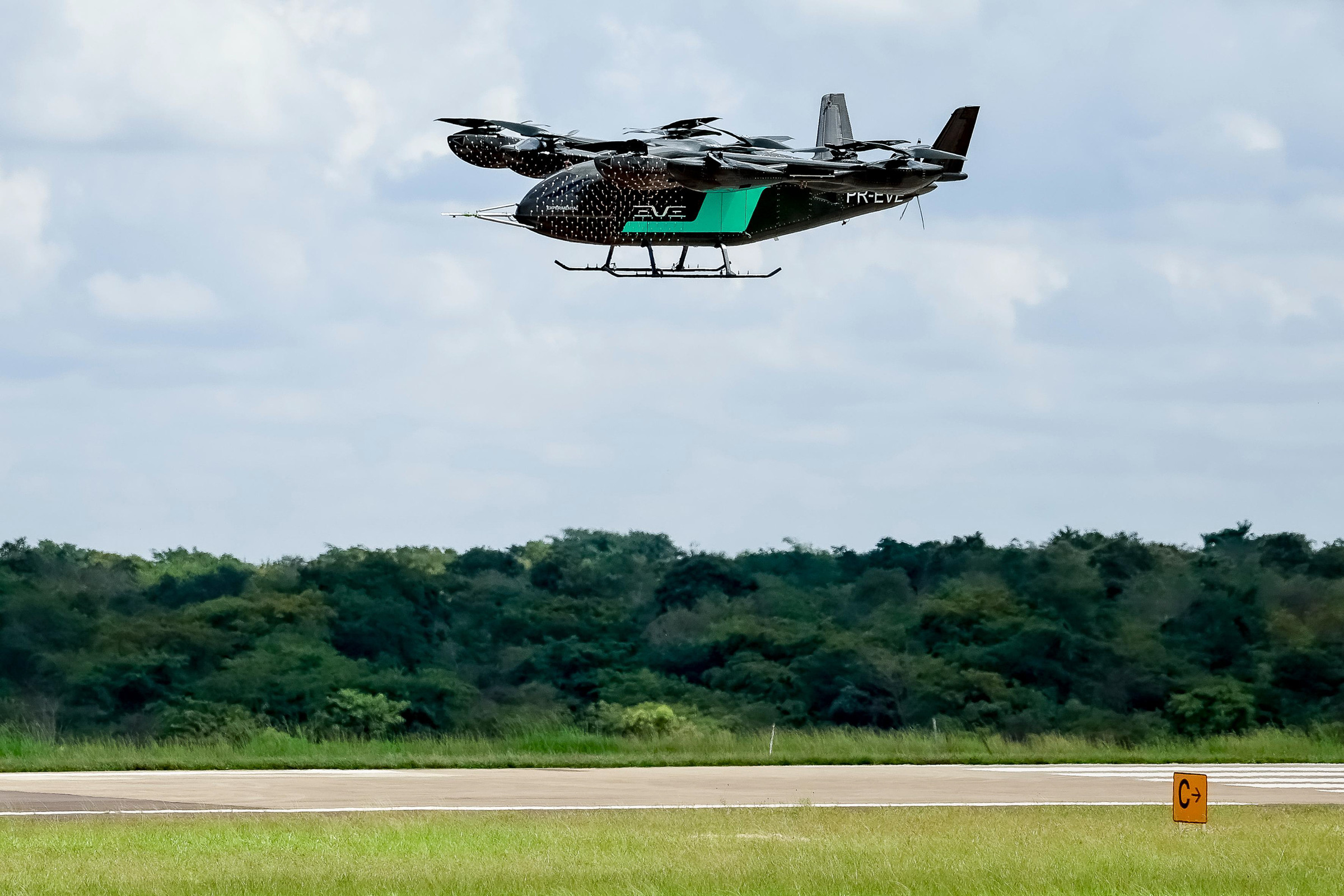
A Brazilian government account of a September 2026 meeting discussed possible first commercial operations in 2028, subject to certification. The discussion also covered the facilities around the aircraft: energy supply, landing infrastructure, fire protection and integration into controlled airspace. Eve’s aircraft would have to enter an operating system capable of charging it, dispatching it and handling its arrivals among other traffic.<sup class="citation"><a href="/sources/#source-171">171</a></sup> The conventional turboprop proposal had taken another course. Embraer had studied a new aircraft for that market, but in July 2026 its chief executive was reported as saying that the project had been shelved. The public statement removed a nearer-term conventional programme from the immediate product discussion, while Energia remained a collection of longer-term technology studies.<sup class="citation"><a href="/sources/#source-172">172</a></sup> The existing E-Jets faced a market that was still replacing older aircraft and changing its networks. Embraer’s 2026 outlook forecast demand for 8,500 new jets with up to 150 seats through 2045. North America accounted for 2,670 of the forecast deliveries, Europe and the CIS for 1,870, and China for 1,470. The remaining demand was spread across Asia-Pacific, Latin America, Africa and the Middle East. These were estimates for the whole market in which Embraer would compete.<sup class="citation"><a href="/sources/#source-173">173</a></sup> Some of that competition would be decided by aircraft already in production. A carrier could replace an older E-Jet with an E2, choose an A220, retain a smaller aircraft for a constrained market, or alter the frequency with which it served a route. A new propulsion system would have to fit into those decisions as well as meet its technical targets. Aircraft that flew less expensively but required unfamiliar infrastructure could impose costs elsewhere in the network.
The E175-E2’s further development pause in February 2025 left the older E175 carrying Embraer’s position in the US market.<sup class="citation"><a href="/sources/#source-94">94</a></sup> For the larger E2s, the immediate work lay in deliveries and support: engines available when required, aircraft completed on schedule and a fleet that could sustain the departures airlines had sold. Energia and Eve opened different possibilities, with different timescales. Any new programme would compete for engineers, investment and production resources with the aircraft Embraer was already contracted to build.