JetBlue’s hundred-seat wager
David Neeleman ordered a second aircraft family while JetBlue was still a young airline. On 10 June 2003, the company committed to 100 E190s and took options for another 100. It then operated 42 Airbus A320s. The new order promised access to medium-sized American markets where Neeleman believed low fares and JetBlue’s service could attract passengers. Each E190 would have 100 seats, arranged two by two, with the leather upholstery and individual satellite television already associated with the carrier. Lease financing had been arranged for the first 30 deliveries. The proposed schedule was ambitious: seven aircraft in 2005, then roughly 18 a year until the firm order was complete. Embraer gained a launch customer prepared to put its name, passenger product and growth plans behind the larger E-Jet. JetBlue accepted the work of introducing another aircraft type in exchange for a smaller unit of capacity with which to expand.
The first passenger service began on 8 November 2005. Flight 1001 left Boston Logan for New York JFK with every seat occupied, one of eight daily trips on the route. JetBlue marked the occasion with a promotion in Manhattan, giving future Boston flight tickets to 190 people wearing blue. On board, the airline carried its familiar entertainment proposition into a 100-seat cabin: live television, satellite radio and seats with 32–33 inches of pitch. The aircraft was sold to customers as a JetBlue experience, with a shorter row of seats and no middle place. The launch also had a practical purpose. Boston–New York supplied an immediate, frequent operation in which the new jet could establish itself before the network widened.81
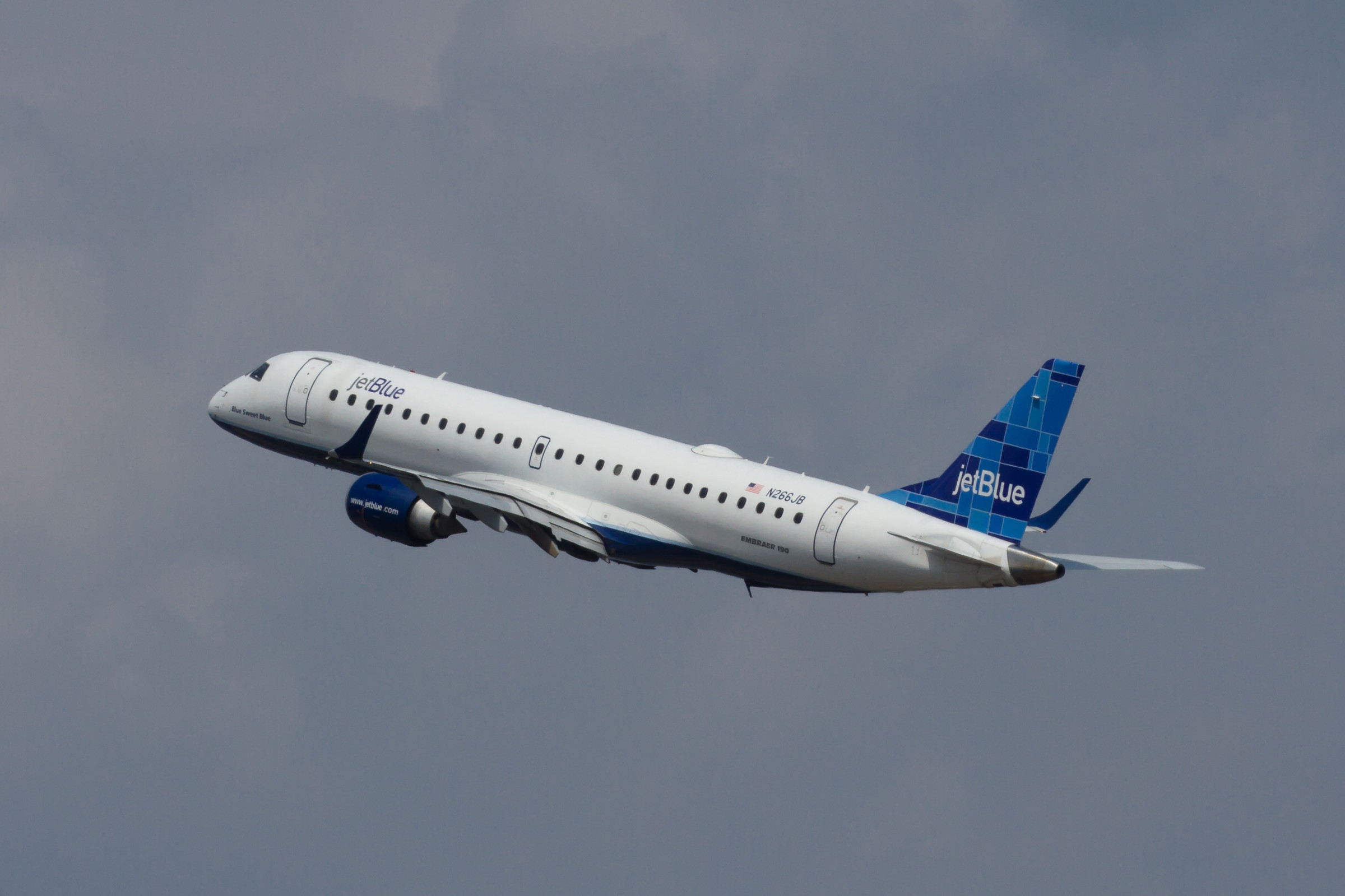
The expansion announced a month earlier made clear what the E190 was expected to do. JetBlue planned new service from JFK to Austin and Richmond, more flights to Buffalo and Burlington, and a substantial increase in Boston flying. The proposed Boston network would connect passengers with cities that the airline had not previously served nonstop from there. Introductory New York–Boston fares started at $25 each way, subject to the published conditions. Behind the publicity lay a schedule built around repetition: several opportunities to leave during the day, then more destinations as deliveries continued. A hundred seats gave JetBlue a way to put its fare and service proposition into markets that needed a different amount of capacity from its A320 routes.<sup class="citation"><a href="/sources/#source-82">82</a></sup> By July 2018, JetBlue’s review of that decision had produced a new answer. It ordered 60 Airbus A220-300s, with options for 60 more, to replace a fleet of 60 E190s. The review included financial analysis and evaluations by frontline staff and technical teams at the JFK hangar. Under chief executive Robin Hayes, JetBlue wanted additional range, more seats and lower costs as it developed its focus cities. The A220 could also open transcontinental opportunities beyond the E190’s role. JetBlue advertised about 40 per cent lower fuel use per seat than its existing E190 configuration, a comparison that combined newer technology with a larger cabin. Deliveries were initially planned from 2020. Alongside the A220 purchase, JetBlue converted 25 A320neo orders to the larger A321neo, making the E190 decision part of a wider reshaping of capacity.<sup class="citation"><a href="/sources/#source-83">83</a></sup> Retirement finally came on 9 September 2025. Flight 190 went from JFK to Boston, returning the farewell to the two cities where E190 service had begun. Chief operating officer Warren Christie captained the flight, as he had the inaugural service almost twenty years earlier; several original crew members and guests joined him. JetBlue had by then received 52 A220s, configured with 140 seats, and had an all-Airbus operating fleet. The extra seats and longer reach changed what the replacement could earn and where it could fly. Yet the farewell also acknowledged what the E190 had accomplished: it had helped establish JetBlue in short-haul markets around New York and Boston, carrying the carrier’s product into cities and schedules that had supported its earlier expansion.84
The final flight did not dispose of the fleet. JetBlue’s 2025 accounts recorded agreements to sell 25 remaining owned airframes, 60 engines and associated spares, with transactions beginning in July and expected to continue into the second quarter of 2026. The company also sold flight simulators and reported a net gain of $32 million from E190 fleet transactions during 2025. Eight owned E190s and three awaiting lease return remained permanently parked at year end. Airframes awaiting sale or lease return remained on the ground after the fare-paying operation had ended.85