Before the first passenger
Before the first E2 flew, Embraer’s engineers had a substantial record of the earlier aircraft to examine. They reviewed data from some seventeen million E-Jet flight hours across different operators and environments. Components selected from that work underwent accelerated life testing and stress screening. Embraer also reported more than thirty thousand digital simulations and virtual or physical ground tests intended to identify possible failures before a prototype left the runway. The company drew on development experience from the Legacy 450/500 and KC-390 and took the main integration role for the E2’s flight-control laws. Engineers who had worked on the original family could return to its behaviour in service while designing replacements for its systems. The resulting test programme began with aircraft already flying for customers, then carried that accumulated experience into new hardware and software.
Moog built a full set of representative flight-control hardware into an integration laboratory. Its iron bird contained electrohydraulic actuators, flight-control electronics and software for actuator control and redundancy management. Test equipment applied simulated aerodynamic loads while the system responded to pilot commands. The arrangement allowed the controls to be exercised together before they were installed in an aircraft making its first flight. Three redundant, dissimilar flight-control computers supervised actuators for the ailerons, elevators, rudder and spoilers. The laboratory examined the devices together under changing loads. By the time Moog described the installation in its 2016 annual report, the E2 had moved from the rig into flight testing, with the laboratory continuing to support qualification of the system.<sup class="citation"><a href="/sources/#source-59">59</a></sup> At 1:06 p.m. on 23 May 2016, the first E190-E2 took off from São José dos Campos. Captain Mozart Louzada flew with first officer Gerson de Oliveira Mendes and flight-test engineers Alexandre Figueiredo and Carlos Silveira. The flight lasted three hours and twenty minutes. The crew retracted the landing gear and flaps, engaged the fly-by-wire system in normal mode, climbed to 41,000 feet and reached Mach 0.82. These were substantial tasks for the first outing of the new aircraft, which had originally been scheduled to fly in the second half of the year. Embraer attributed the breadth of the flight to preparation through modelling, ground tests and the iron bird. The first prototype was now producing airborne data across speed, altitude and configuration changes, beginning the campaign that would qualify the aircraft for passenger service.<sup class="citation"><a href="/sources/#source-60">60</a></sup> A fourth E190-E2 prototype made its first flight in March 2017. Its work concentrated on the interior: evacuation, environmental comfort and cabin noise. The new aircraft therefore acquired a test vehicle devoted to the space passengers and crews would occupy. Conditions inside the cabin joined the aerodynamic and systems work already under way on the other prototypes. Seats, fittings, air supply and the enclosed cabin had to be assessed as an operating environment before the first airline received the aircraft.<sup class="citation"><a href="/sources/#source-61">61</a></sup> The E195-E2 followed on 29 March 2017, taking off at 11:22 a.m., only three weeks after rollout. Márcio Brizola Jordão and José Willi Pirk flew the aircraft with engineers Celso Braga de Mendonça and Mario Ito. During two hours in the air, the crew evaluated handling and systems, including the autopilot, direct-mode fly-by-wire operation and landing-gear retraction. Embraer allocated two aircraft to this campaign: one for aerodynamics and performance, the other for the interior and validation of maintenance tasks. The longer-winged, stretched aircraft could draw on the E190-E2’s development while adding evidence specific to its own airframe. Its first flight brought the second production model into the programme ten months after the E190-E2.<sup class="citation"><a href="/sources/#source-62">62</a></sup> On 28 February 2018, Embraer received E190-E2 certification from ANAC, the FAA and EASA. Fifty-six months had elapsed since the programme launch. The four flying prototypes had accumulated more than two thousand hours, while laboratory rigs had completed roughly forty-five thousand hours on avionics, controls, electrical, hydraulic and environmental systems. Embraer reported that seventy-five per cent of the aircraft’s systems were new compared with the original E190. The company also said that the measured fuel performance exceeded its initial target, giving a 17.3 per cent improvement over the first-generation aircraft. Certification closed the principal development campaign in time for the planned 2018 introduction. The E190-E2 could now leave the test organisation and enter an airline fleet, carrying the new wing, landing gear, propulsion and control systems into scheduled operations.<sup class="citation"><a href="/sources/#source-63">63</a></sup> The E195-E2 received the same three authorities’ approvals on 15 April 2019. Its two prototypes had completed the work divided between performance and aerodynamics, cabin evaluation and maintenance validation. Embraer reported fuel consumption 1.4 per cent better than its original specification and a 25.4 per cent reduction per seat against the earlier E195. That comparison included the effect of the larger cabin as well as the new aircraft’s fuel consumption. The company announced a basic-check interval of ten thousand flight hours, with no calendar limit for typical utilisation. The certified design was ready for its first delivery later that year. The second E2 would enter service with more seats than any previous Embraer airliner, following a distinct certification campaign built on the earlier model’s engineering work.64
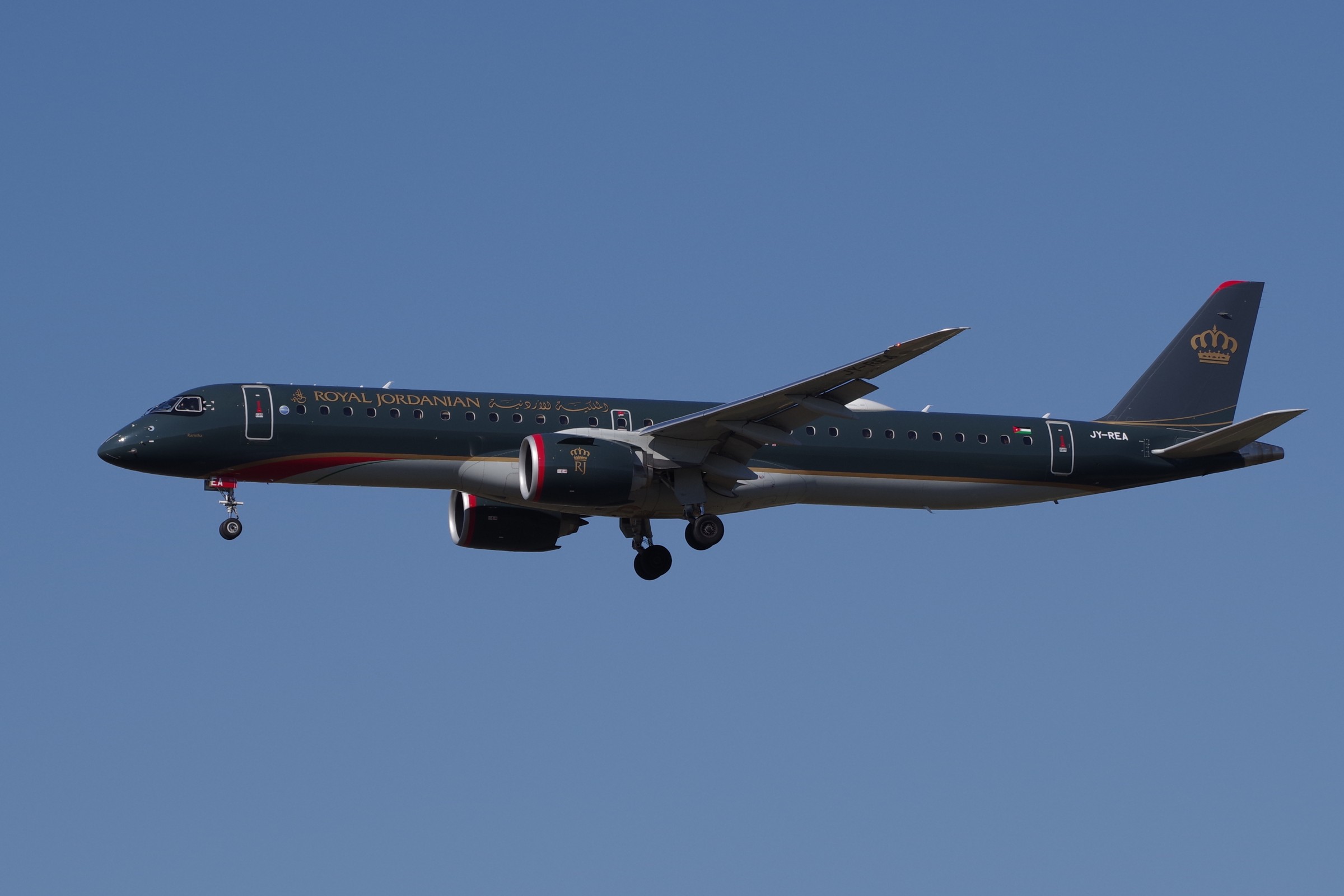
By March 2024, the E2 had acquired another approval that changed where airlines could take it. ANAC, the FAA and EASA had cleared the E190-E2 and E195-E2 for ETOPS-120 operations. The limit concerned diversion time at the approved one-engine-inoperative cruise speed. It allowed suitably approved operators to plan more direct tracks over water or remote land, where the nearest suitable diversion airport could otherwise force a detour. Embraer had waited longer than expected for that capability. Pandemic reductions in flying had delayed the accumulation of the fleet experience required for approval. For airlines considering routes across an archipelago or along a remote coast, that experience now had a practical consequence in the route they could plan.65